

This article was written by Aled Hanson
The cultural phenomena of ‘memes’ is relatively recent. The term was coined by Richard Dawkins in his 1976 book ‘The Selfish Gene’ in order to describe a unit of cultural information spread by imitation. Even Dawkins couldn’t have predicted the significance this term would take on decades later, as the widespread use of social media created the perfect conditions for memes to spread across the internet like wildfire.
In an interview with the New York Times (2022), Kirby Conrod, a professor of linguistics at Swarthmore College, stated:
‘I would explain the concept of a meme – a self replicating chunk of information – by asking someone about an inside joke they had with friends or an advertising jingle that’s been stuck in their head for 20 years. That chunk of information, the joke or the jingle, self-replicates because we humans like to share and repeat stuff’
As the idea, or joke, is replicated again and again, before long it becomes part of the public consciousness, at least on the internet.


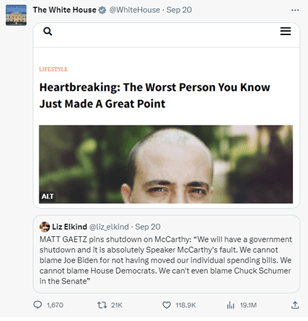
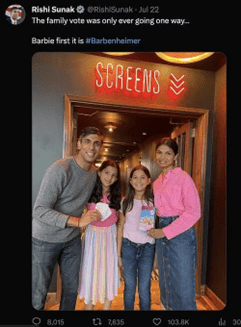
Memes have long outgrown the corners of the internet, and now provide a way to gain traction, popularity and interest by some of the most powerful figures in the world. Whether this is the White House’s official X (formally ‘Twitter’) account, or Rishi Sunak’s rush to get in on the ‘Barbenheimer’ meme where audiences flocked to see Oppenheimer and Barbie on the same day due to an trend which ripped quickly through the internet, and made Barbie one of the highest grossing films of all time.
So, ‘memes’ become mainstream, what lessons can educators learn from this new online cultural phenomenon?
In their paper Memes and Education: opportunities, approaches and perspectives, Dongqiang et al (2020) state:
‘Memes are a new type of carrier which can carry the content of student learning in visual representations; they can also be manipulated and used by teachers, and accepted by students since their inception… memes can effectively convey educational content and are an important bridge and link between teachers and students’

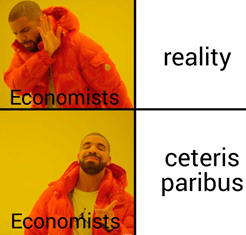
Memes can also allow students to explore complex subject knowledge in an accessible way, allowing students to access new information, or enhance their knowledge and understanding. Beyond this, memes can even be incorporated into student tasks and homework, in order to cement understanding. Brown (2020) set pharmacy students a task where they were asked to convert key areas of subject content into memes themselves.
In their post-assignment reflection, Brown (2020) highlights that,
‘[w]hilst not formally evaluated, this meme assignment displayed an overall ability of students to apply challenging course concepts to create new memes. Moreover, this assignment was positively accepted by students and feedback suggested that the activity supported an active learning environment amongst group members’
This demonstrates that using ‘memes’ more within lessons can serve a dual purpose: by (i) fostering positive relationships between teachers and students based on shared understanding; and by (ii) widening students’ subject knowledge.
As the idea of ‘fake news’– hoax news stories spread throughout the internet– began to enter the public consciousness following the 2016 presidential election, many schools began to adapt their PSHE offer, providing students advice on trusted news organisations and how to stop fake news. Knobel (2006) suggests the same approach should be taken with ‘memes’.
‘Meme analysis can also include tracing where or how certain memes were most likely acquired, what effects these memes have on decision making, mindset and actions, the effects these memes may have on other people and what ethical decisions need to be made with respect to passing on, or not passing on, certain memes to other minds’
As the internet becomes more a part of our daily lives, it is important that educators adapt to this changing context.
The three key lessons I suggest taking from this research are as follows:
- The use of memes in teaching resources can help promote a shared understanding, both of subject knowledge, and cultural trends, which can develop both students abilities and the working relationship between teachers and students.
- The use of memes in an educational setting operates best with a holistic approach, looking for unique ways they can be integrated into the classroom. An example of this might be a task which asks students to create a ‘meme’ which refers to a key area of subject knowledge, particularly one which might be more difficult to grasp.
- As memes become a more significant part of our shared culture, both on and offline, it is important that schools adapt their PSHE offer to give students an understanding of what memes are, the cultural roles they play, and the ethical issues the emergence of memes create.
To finish on the subject of ‘meme literacy’, educators must be conscious that certain images carry crude or nefarious connotations because of the memes which have been created out of them. Teachers who use memes need to be ‘meme aware’ as it were; and, conversely, should not simply search the internet blindly for random memes that might seem contextually appropriate to what they are teaching. Nevertheless, the increasing popularity and impact of social media in recent decades cannot be ignored – social media continues to have wide ranging effects on society, elections, and our shared understanding and view of the world. It is important that our classrooms adapt to this changing atmosphere, to ensure that students are in the best position to navigate such a changing world.
References
Benveniste, A. (2022) The meaning and history of memes, The New York Times. Available at: https://www.nytimes.com/2022/01/26/crosswords/what-is-a-meme.html (Accessed: 05 October 2023).
Brown, Joshua D. 2020. “What Do You Meme, Professor? An Experiment Using “Memes” in Pharmacy Education” Pharmacy 8, no. 4: 202. https://doi.org/10.3390/pharmacy8040202
Dongqiang X.,De Serio L.,Malakhov A. and Matys O. (2020) Memes and education: opportunities, approaches and perspectives. Geopolitical, Social Security and Freedom Journal, Vol.3 (Issue 2), pp. 14-25. https://doi.org/10.2478/gssfj-2020-0009
Michele Knobel,E-Learning and Digital Media 2006 3:3, 411-427, Memes and Affinity Spaces: Some Implications for Policy and Digital Divides in Education
 Megapedagogy
Leave a comment